
Forget the Fleets. Watch the Foundries
In the world of grand strategy, we usually talk about aircraft carriers and ballistic missiles. It’s antiquated. In 2026, the most potent deterrent on the planet isn’t a weapon system. It’s a clean room in Hsinchu.
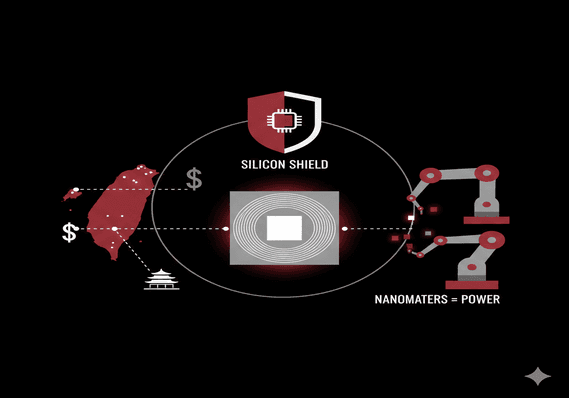
Welcome to the Silicon Shield.
Taiwan produces 90% of the world’s most advanced semiconductors. If that production stops, the global economy doesn’t just slow down; it disintegrates. This is the ultimate “exorbitant privilege” of the tech age.
The Strategy of Indispensability
The Silicon Shield isn’t about military might. It’s about being too important to fail. It’s the ultimate marketing play: indispensability.
The theory is simple. The U.S. has to defend Taiwan because without TSMC, the American tech sector is a hollow shell. And China? They’re the island’s biggest customer. An invasion that damages those foundries would be the most expensive suicide note in history.
Beijing knows it. Washington knows it. And Taipei counts on it.
The Cracks in the Shield?
But the shield is under pressure. Everyone is panicking. The U.S. is throwing billions at the CHIPS Act, trying to “re-shore” production to Arizona. China is pouring state capital into their own “good-enough” silicon.
Is the shield weakening? Hardly.
Taiwan isn’t sitting still. While the rest of the world is building the technology of today, Taiwan is already mastering the technology of tomorrow.
By keeping the most advanced, cutting-edge processes on the island, they ensure that the path to the AI future still runs through them.
It’s a race against global diversification, and Taiwan is currently a lap ahead.
This leaves Washington in a state of perpetual strategic anxiety. You can’t simply “re-shore” twenty years of specialized R&D and a hyper-concentrated talent pool with a few billion dollars in subsidies.
For the global order, it means the traditional levers of power—treaties and aircraft carriers—are being superseded by a more fundamental reality: if you don’t have the silicon, you don’t have the sovereignty.
Geopolitics and technology have merged. You can’t understand one without the other. Taiwan’s Silicon Shield is a masterclass in strategic positioning. It’s a reminder that in 2026, power isn’t about who has the most land. It’s about who controls the nanometers.
For the prudent investor, the lesson is clear: don’t just watch the headlines. Watch the yields out of the Taiwanese foundries. That’s where the real power lies.