
AI has transitioned from a simple tool to the core engine of modern trading. In 2026, relying solely on intuition and legacy charts is no longer a sustainable strategy for outperformance. The shift toward Agentic AI and high-fidelity prediction signals represents a fundamental evolution, offering a level of precision that traditional technical analysis simply cannot match.
Let’s be honest. Most of you lot are still trading like it’s 2004. You pull up a chart, squint at some moving averages, and think you’ve got an “edge.” Newsflash: you don’t. In 2026, Artificial Intelligence hasn’t just joined the party; it’s bought the house and is currently kicking everyone else out.
If you want to survive—let alone thrive—in this market, you need to stop playing around with “discretionary” nonsense and start orchestrating a digital army.
The Rise of Agentic AI: Your New Digital Overlord
The biggest shift we’ve seen is the mainstreaming of Agentic AI. This isn’t your grandfather’s “if-then” algorithm. These systems are autonomous. They don’t just follow a script; they follow a strategy. They plan, they adapt, and they execute across multiple steps without needing a human to click “buy.”
Unlike traditional bots that break the moment market conditions shift, Agentic AI utilizes a reasoning layer to handle edge cases. It manages its own “thinking” process: identifying the best execution path, monitoring for slippage, and self-correcting when a trade isn’t hitting its benchmarks.
Think of it as having a 24/7 digital fund manager that doesn’t sleep, doesn’t get emotional, and doesn’t care about your “feeling” that the market is due for a bounce. It’s the difference between a tool that waits for instructions and an employee that delivers results.
From Price Signals to Prediction Signals
Back in the dark ages (the 2010s), we focused on price signals. What did the price do? Today, that’s redundant. 2026 is about prediction signals. Advanced neural networks are now sniffing out demand and sentiment before it ever hits the tape. If you’re waiting for the price to move before you act, you’re already behind. AI is reading the menu while you’re still trying to figure out where the restaurant is.
Augmented Human Trading: The ‘Centaur’ Model
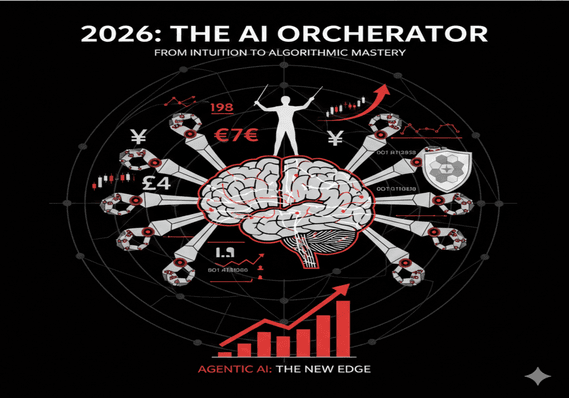
Now, I’m not saying you should throw your keyboard out the window just yet. The real winners are the ‘Centaurs’—humans who have the sense to get augmented. You set the philosophical direction, the risk appetite, and the ethical boundaries. The AI does the heavy lifting: the 24/7 global scanning, the massive data crunching, the execution. You’re the conductor; the AI is the orchestra. Stop trying to play every instrument yourself.
Risk Management 4.0: Stop Being So Emotional
The reason most of you fail isn’t your strategy; it’s your head. You hold losers too long and cut winners too short because you’re human. AI doesn’t have that problem. In 2026, top-tier risk systems use reinforcement learning (RL) to move beyond the “static stop-loss” era.
To implement Risk Management 4.0, you need to move from fixed percentages to Dynamic Volatility Scaling:
1. Volatility-Adjusted Sizing: Instead of risking 1% of your account per trade, use an AI agent to calculate position size based on the 24-hour Expected Move (derived from options IV or GARCH models). If volatility spikes, your size automatically shrinks before the hit happens.
2. The RL Defense Layer: Deploy a reinforcement learning model trained specifically on “maximum adverse excursion.” This agent’s only job is to monitor the trade’s health. If the order flow dynamics shift against you, it doesn’t wait for a stop-loss; it executes a “soft exit” or scales out 50% to de-risk.
3. Automated Correlation Hedging: When your AI detects high systemic risk (e.g., a sudden correlation spike across your portfolio), it should automatically open micro-hedges in inversely correlated assets (like put options or inverse ETFs) to neutralized delta without closing your primary alpha positions.
It’s not a static safety net; it’s a living, breathing defense system. It’s boring, it’s clinical, and it’s the only way to survive a flash crash in a machine-dominated market.
Mastering AI trading in 2026 isn’t about being a better technical analyst. It’s about being a better orchestrator. It’s about moving from the “doing” to the “directing.” The tech is here, it’s institutional-grade, and it’s accessible. So, are you going to embrace the AI infrastructure, or are you going to keep staring at your charts until the lights go out?
Your choice. But don’t say I didn’t warn you.