
The AI Delusion Meets the Silicon Reality
Building on yesterday’s analysis of the AI infrastructure craze, we need to examine this shift from a more cynical, and frankly, more accurate perspective. While the tech evangelists are busy preaching about the “Intelligence Age,” they’re missing the physical bottleneck. We’ve looked at the models; now we must look at the machines. AI isn’t just a software race—it’s a competition for the hardware too. Simply having the code isn’t enough; you need the underlying infrastructure and, most importantly, the specialized silicon required to fuel massive computing power.
In 2026, the winners won’t be decided by who has the best algorithms, but by who controls the atoms.
Welcome to Pax Silica.
It’s the most important initiative you’ve never heard of. Launched in late 2025, this U.S.-led reconfiguration of the global economy is shifting the power from those who write the algorithms to those who control the atoms.
What is Pax Silica?
Forget broad trade agreements. They’re dead. Pax Silica is a targeted, brutalist reconstruction of the semiconductor life cycle. It’s a “who’s who” of tech hubs—Japan, Korea, Singapore, the Netherlands, Israel, the UAE, and the UK—united under one banner.
The goal? Simple. A functional network that links everything from rare earth extraction to the final, high-performance logic chip. It’s about building a technological peace — a Pax — etched in silicon. If you aren’t in the network, you’re irrelevant.
The Primary Targets:
-
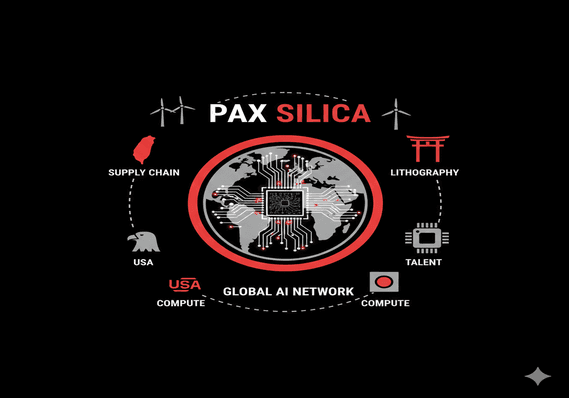
Supply Chain Sovereignty: Moving beyond “just-in-time” manufacturing to “just-in-case” redundancy. This involves mapping every single point of failure—from neon gas suppliers in Ukraine to photoresist chemical plants in Japan—and ensuring they are within the alliance’s defensive perimeter.
-
Lithography Monopolization: Formalizing the chokehold on Extreme Ultraviolet (EUV) and High-NA lithography. By aligning the Netherlands (ASML) and Japan (Tokyo Electron, Nikon) with U.S. security interests, the alliance ensures that the machinery required for sub-2nm nodes never leaves the “trusted” circle.
-
Compute Cartels: Establishing a unified protocol for the distribution of high-end GPUs and NPUs. Pax Silica isn’t just about making chips; it’s about deciding who gets to buy them. It’s the creation of a “Compute OPEC” that can throttle the AI development of any non-aligned state.
-
The Talent Moat: A coordinated visa and R&D framework designed to aggregate the world’s top 0.1% of semiconductor engineers into the network’s hubs, effectively starving adversarial nations of the human capital required to innovate independently.
Why Branding “Resilience” Matters
For decades, the tech industry was obsessed with “efficiency.” It was a marketing lie. What they meant was “cheap.” And cheap meant putting all our eggs in one very brittle basket. One earthquake or one political tantrum, and the whole world stops.
Pax Silica is the rebrand. We call it “Resilience” now.
It’s about friend-shoring. It’s about ensuring that the brain of your next AI-driven investment isn’t subject to someone else’s sanctions. This isn’t just a vague alliance; it’s a functional specialized division of labor:
-
The United States (The Architect & Enforcer): Provides the core IP, the massive end-user market, and the security umbrella that keeps the trade routes open.
-
The Netherlands & Japan (The Toolmakers): ASML, Tokyo Electron, and Nikon hold the keys to the lithography and chemical kingdoms. Without them, you’re carving stone tablets, not 2nm chips.
-
South Korea (The Foundry & Memory Hub): Samsung and SK Hynix provide the sheer industrial scale for logic and HBM (High Bandwidth Memory) that AI requires to function.
-
Singapore (The Logistics Node): The neutral ground for advanced packaging and high-security distribution.
-
Israel & The UK (The Design Architects): The source of the most sophisticated AI hardware architectures and specialized IP.
-
The UAE (The Compute Bank): Providing the massive capital and energy-intensive data center infrastructure required to host the “Compute OPEC” reserves.
By diversifying manufacturing and building shared reserves, this network is building a buffering mechanism against the chaos of the 21st century.
Pax Silica is a declaration of intent. It integrates geopolitical loyalty directly into the AI economy, creating a world where allies are hard-coded into the technological stack and everyone else is relegated to client status. But this digital iron curtain is also a blueprint for future conflict. By institutionalizing exclusion, the network risks turning technological disparity into an existential threat for the un-aligned, transforming today’s trade sanctions into the casus belli for tomorrow’s kinetic wars.
For the investor, the message is clear: the path to prosperity is no longer just about who has the best idea. It’s about who controls the infrastructure that powers it.
The silicon shield is rising, and you’d better be on the right side of it.