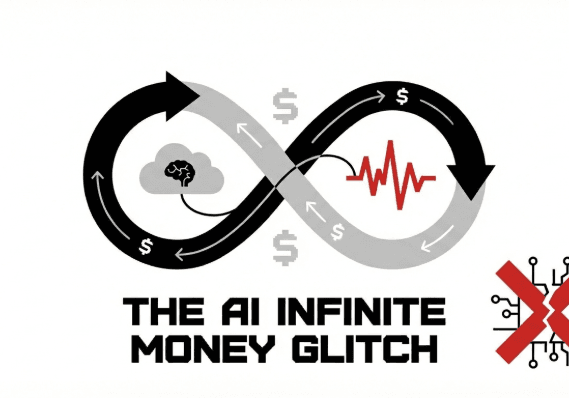

The “AI Infinite Money Glitch” is a closed-loop accounting miracle where tech giants trade the same billions back and forth for chips and cloud space. It’s a masterclass in marketing performance art, but unless real-world utility starts footing the bill, this digital hall of mirrors is headed for a messy reality check.
Listen, I’ve seen some staggering corporate hype cycles in my time, but the “AI Infinite Money Glitch” is in a league of its own. Everyone’s running around acting like the laws of economics have been suspended, treating generative AI like a discovery of digital alchemy.
It’s all “GPT this” and “NVIDIA that,” but if you look under the hood, it’s mostly just a few tech giants moving capital in a very expensive, very fast circle.
It’s the kind of financial performance art that would make even the most aggressive venture capitalist pause for breath.
The Hall of Mirrors
Here’s the rub: NVIDIA gives cash to OpenAI. OpenAI uses that cash to buy NVIDIA chips. Then they rent space from Microsoft or Oracle to run those chips. Microsoft, in turn, buys more chips from NVIDIA to keep the startups happy. It’s a circular economy that would make a sustainability consultant weep with joy. But let’s call it what it is: marketing performance art.
This is essentially a high-stakes game of vendor financing. When a cloud provider invests in an AI startup that is then contractually obligated to spend that investment on the provider’s own infrastructure, the resulting revenue is an accounting reality but an economic fiction. It creates a closed loop where capital never actually leaves the ecosystem to solve a problem for an external customer. For this to be a sustainable industry rather than a temporary balance-sheet miracle, the cash eventually has to come from someone who isn’t already on the cap table.
The Real Demand Problem
The problem with a glitch is that it’s usually a bug, not a feature. We are front-loading billions in infrastructure costs on the hope that some accountant in Mumbai or a marketer in London will find a way to make their life 10% easier with an LLM. Currently, the “value” is all speculative. We’re selling the shovel to the gold miners, but the miners haven’t found a single nugget of real revenue yet.
If we don’t see actual, non-circular, cold-hard-cash demand soon, this loop is going to unwind. And when it does, it won’t be a “glitch”—it’ll be a bloody catastrophe.
The AI investment cycle is a significant demonstration of market hype, but it remains largely disconnected from sustainable economic utility. To move forward, the industry must shift its focus from circular revenue models toward solving tangible problems for external customers. The long-term viability of this technology depends on whether it can generate value that users are willing to pay for directly. Without a transition to genuine, non-circular demand, the current expansion is vulnerable to a sharp correction. Success will be determined by real-world application, not just capital rotation.